
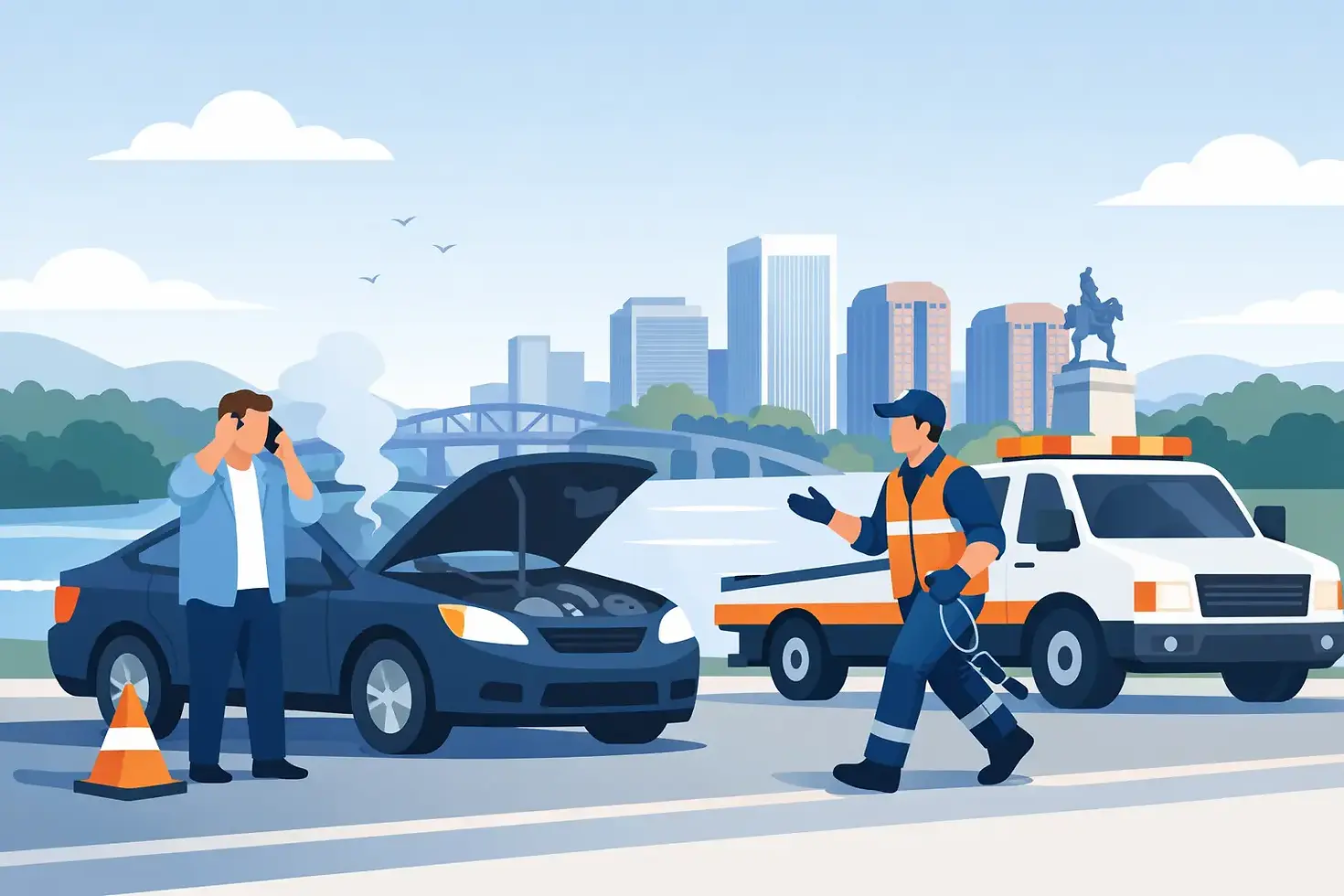
When to Call Roadside Assistance in Richmond
A flat tire on I-95, a dead battery outside work, or keys sitting on the driver’s seat can turn an ordinary day into a stressful one fast. Knowing when to call roadside assistance helps you make a safe decision before a small problem becomes a dangerous roadside situation. If you are stranded in Richmond or the surrounding RVA area, the first priority is not fixing the vehicle yourself. It is getting yourself and your passengers to a safer position.
Call Roadside Assistance When Safety Is in Question
You do not need to wait for a complete breakdown to ask for help. If traffic is moving quickly around you, visibility is poor, or you are unsure what is wrong with the vehicle, calling for roadside help is often the right choice.
Pull as far off the road as you safely can, turn on your hazard lights, and stay aware of your surroundings. On busy stretches of I-95, I-64, I-295, and local Richmond roads, stepping outside your vehicle can put you close to fast-moving traffic. If you are on a narrow shoulder, near a curve, in heavy rain, or stopped after dark, avoid trying to handle the repair alone.
Call 911 first if there has been a collision, anyone is injured, your vehicle is blocking traffic, or you feel unsafe because of another person nearby. For a non-injury breakdown, lockout, flat, dead battery, or fuel issue, roadside assistance can get help moving without the uncertainty of trying to find a repair shop or tow truck on your own.
You Have a Flat Tire and Cannot Change It Safely
A flat tire is one of the most common reasons drivers get stranded, but it is not always a safe do-it-yourself job. You should call for help if the tire went flat on a highway shoulder, you do not have a working spare, the lug nuts will not move, or you are not comfortable using a jack.
Modern vehicles can also complicate a simple tire change. Some cars do not include a spare tire, and some locking lug nuts require a special key. If the tire sidewall is damaged, the wheel is bent, or more than one tire is flat, a roadside tire change may not be enough. A tow may be the safer next step.
Do not drive on a fully flat tire just to reach a gas station or parking lot. That can damage the wheel and make an affordable tire repair into a more expensive replacement. If you can safely pull over, stop and call.
Your Battery Is Dead or the Car Will Not Start
You turn the key or press the start button and get clicking, dim lights, or no response at all. A jump start may solve the problem, but it is wise to call roadside assistance when you do not have jumper cables, are parked somewhere isolated, or do not know whether the battery is the real issue.
Not every no-start situation is a dead battery. It could be a failing alternator, starter problem, loose battery connection, or an issue with the vehicle’s electrical system. If your battery has needed several jumps lately, the car dies again soon after starting, or a battery warning light is on, do not assume a jump will keep you moving for long. You may need a tow to avoid being stranded again a few miles down the road.
A trained roadside technician can assess the immediate situation and help you decide whether the vehicle is safe to drive after a jump. That clarity matters when you are trying to get to work, pick up a child, or make it home late at night.
When to Call Roadside Assistance for a Lockout
Locked keys in a car can feel embarrassing, especially when you are running late. It happens to careful drivers every day. Call for lockout assistance instead of forcing the door, breaking a window, or trying online tricks that could damage the weather stripping, lock mechanism, or airbag components.
This is especially true for newer vehicles with electronic keys, key fobs, and side-impact airbags in the doors. A quick attempt with the wrong tool can turn a lockout into a costly repair. Professional lockout help is usually the faster, safer option.
If a child, pet, or vulnerable person is locked inside a vehicle, call 911 immediately. Heat can build up quickly, even when the weather does not feel extreme. For a standard lockout with no one trapped inside, stay near your vehicle in a safe, visible location and arrange assistance.
You Ran Out of Gas
Running out of gas is frustrating, but it does not need to become a long walk down a busy road. If you are safely parked and simply need enough fuel to reach the nearest gas station, fuel delivery can get you moving again without leaving your vehicle behind.
Do not walk along a highway shoulder with a gas can. It is risky, especially at night or during bad weather. It can also be hard to tell exactly how far the next station is when you are stranded outside the city or along a major corridor.
Before calling, check your location as accurately as possible. Look for a mile marker, nearby exit number, cross street, business name, or landmark. Clear location details help the roadside provider find you faster.
The Vehicle Is Overheating, Smoking, or Leaking Fluids
Some vehicle problems are not roadside fixes. If the temperature gauge is in the red, steam is coming from under the hood, you smell burning, or you see a significant fluid leak, pull over safely and turn off the engine. Continuing to drive can cause serious engine damage or create a fire risk.
Never remove a radiator cap from a hot engine. The cooling system may be under pressure, and hot coolant can cause severe burns. Let the vehicle cool and call for towing if you are unsure whether it can be driven.
The same rule applies to serious warning lights, grinding noises, a loss of steering, brake trouble, or a vehicle that shakes violently. Your destination can wait. A tow is the better call when driving farther could endanger you or other motorists.
When a Tow Is Better Than a Quick Fix
Roadside assistance is not only for minor inconveniences. Sometimes the most helpful service is towing the vehicle to a repair facility, home, or another safe location.
Call for a tow if your car will not start after a jump, has been in an accident, has mechanical trouble that makes it unsafe to drive, or cannot be repaired where it is parked. You should also request towing if the vehicle is stuck, has a damaged wheel, has a broken belt, or has a warning light paired with poor performance.
It depends on the situation. A single flat tire in a safe parking lot may only require a tire change. A flat tire on a crowded interstate, combined with wheel damage and no spare, calls for a tow. The goal is not to spend more than necessary. The goal is to choose the service that gets you out of danger and prevents added damage.
Richmond Roadside provides 24/7 local help for lockouts, jump starts, flat tires, fuel delivery, and towing throughout Richmond and nearby RVA communities. When you call, explain what happened, where you are, the make and model of your vehicle, and whether you are in a safe location. That helps the right assistance reach you without delays.
What to Do While You Wait
After you request help, keep your hazard lights on and remain in the vehicle if it is safe to do so. Keep doors locked, especially if you are alone or stopped at night. If you must exit because the vehicle is unsafe or has smoke or fire, move well away from traffic and stand behind a barrier when one is available.
Have your phone charged if possible, and share your precise location with the dispatcher. Avoid accepting help from strangers unless you feel completely safe and have no other option. A professional roadside technician should be able to identify the service they are providing when they arrive.
A roadside emergency rarely happens at a convenient time. Trust your instincts: if the road feels unsafe, the vehicle feels unreliable, or the repair is beyond your comfort level, call for help. A fast, local response can turn a stressful stop into a short delay and get you back to your day with confidence.


Comments